
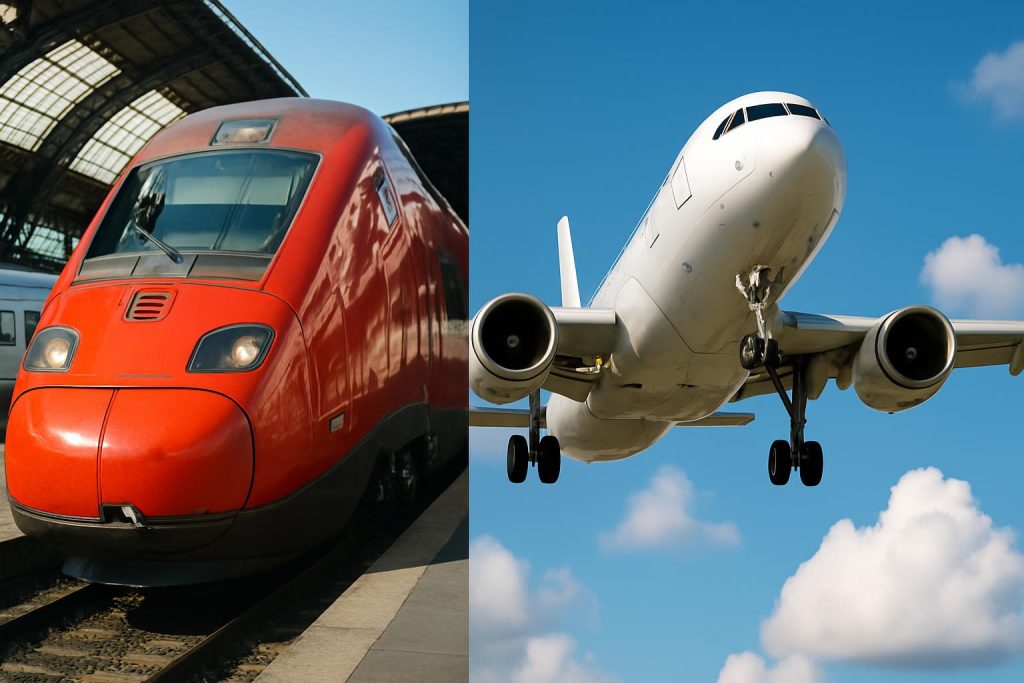
- 4-day Eurail Global Pass prices start around $229 (youth) and $306 (adult) for 2026
- Budget airline base fares often range €15–€80 one-way before bags and seat fees
- The cheaper option depends on number of countries, booking lead time, and flexibility needs
- Hidden reservation fees can significantly change the real cost of a Eurail Pass
Eurail Passes vs Budget Airlines in 2026: What Actually Costs Less?
For a typical multi-country Europe trip in 2026, a 4-day Eurail Global Pass starts around $229 for youth and $306 for adults, while budget airline base fares on the same routes often run €15–€80 one-way before bags and seat selection are added. Trainline lists official 2026 Eurail Global Pass starting prices at these levels, and multiple budget carrier trackers confirm similar entry-level airfares across the continent. Neither option is a flat “cheaper” answer — it depends entirely on how many countries you’re hitting, how far ahead you book, and whether you value flexibility over rock-bottom price.
This guide breaks down the real numbers: pass prices by age bracket, hidden reservation fees that Eurail’s own marketing tends to downplay, and the true all-in cost of flying Ryanair or Wizz Air once baggage and seat fees are added. We’ll also map out exactly which traveler profile should buy which option, using verified 2026 pricing rather than guesswork.
The short version: rail passes win for spontaneous, multi-country loops through reservation-free zones like Germany, Austria, and Scandinavia, while budget flights usually win for point-to-point hops booked weeks in advance, especially across longer distances or between countries not well connected by fast trains. The rest of this article shows exactly where that line falls.
What Drives the Cost — Pass Type, Age Bracket, and Booking Window
Three variables decide almost all of your transport cost in 2026: your age bracket (youth discount), how far ahead you book, and whether your route touches a “reservation-heavy” country like France, Italy, or Spain. Missing any one of these in your planning is the single biggest reason travelers overpay on either option.
On the rail side, Eurail’s youth pass offers up to 25% off adult prices for travelers aged 12–27, while seniors 60 and older get a 10% discount. Children aged 4–11 travel free with a paying adult, though reservation fees still apply even for free child passes. On top of the base pass price, many high-speed and international trains require a separate paid seat reservation — this is the cost that catches first-time pass buyers off guard, since it’s easy to assume “unlimited travel” means zero extra fees.
How Eurail Reservation Fees Actually Work
Reservation costs vary dramatically by country, and this is where a lot of the “is Eurail worth it” debate actually lives. Germany’s ICE and IC trains are largely reservation-optional, with an optional second-class reservation costing around €5.50, while France’s TGV-Lyria trains to Switzerland charge passholders €29–€39 per reservation with limited quotas that sell out in summer. Night trains add another layer — a seat reservation can run €10–15, a couchette in a shared compartment €15–50, and a private sleeper cabin €50–200+, according to Eurail-focused route planning guides.
How Budget Airline Pricing Actually Works
Budget airlines follow a completely different cost structure: rock-bottom base fares that get inflated by add-ons. Comparing Ryanair and Wizz Air, base fares on overlapping routes typically start at €15–25 for early bookings, but a 10kg checked bag adds €12–30, priority boarding adds €5–35, and seat selection adds €2–25 depending on the carrier. Airport check-in fees for skipping online check-in can run €35–55. The result is that a “€19 flight” easily becomes a €70–90 door-to-door cost once you add one checked bag and a seat assignment.

Cost Breakdown: Eurail Pass vs Budget Airline for the Same Multi-City Route
The clearest way to compare the two is to price out one realistic itinerary both ways. Below is a cost breakdown for a 2-week, 4-country loop (Amsterdam → Paris → Zurich → Milan → back to Amsterdam), using verified 2026 figures.
| Cost Item | Eurail Route (2nd class) | Budget Airline Equivalent |
|---|---|---|
| Base transport cost | 7-day Flex Pass (Adult, 2nd class): approx. $473 / €440 | 3 one-way Ryanair/Wizz legs at €25–€80 each: approx. €150–240 |
| Amsterdam–Paris leg | Included + ~€35 reservation fee | €30–70 base fare |
| Paris–Zurich leg | Included + ~€29–39 reservation fee | €40–80 base fare |
| Checked bag (10kg, one-way) | Not applicable — free on trains | €12–45 per flight, per direction |
| Seat selection | Bundled into reservation fee | €2–25 per flight |
| City center access | Arrives in city center, no extra cost | €15–30 extra bus/train if secondary airport |
| Estimated realistic total | ~€500–540 all-in | ~€280–420 all-in (varies heavily by booking window) |
How we calculated: Pass pricing verified via Trainline’s official Eurail retailer page and Eurail.com; reservation fees verified via EveryRail’s seat reservation guide (checked June 2026); airline fees verified via AiFly’s Ryanair vs Wizz Air 2026 fee comparison. Figures verified July 2026.
What this table shows is that the pass isn’t automatically cheaper — on a route like this, with only three long-distance legs and mandatory French and Swiss reservations, budget flights booked early can actually undercut the pass. The pass becomes more competitive as you add more legs, since reservation fees stay relatively flat per journey while flight base fares repeat in full each time you book a new route.
When the Rail Pass Actually Wins on Price
A Eurail pass pulls ahead once your itinerary includes 5 or more long-distance journeys across 3+ countries, especially through reservation-free rail networks. This is the core finding echoed across independent 2026 rail-pass analyses: the math shifts heavily based on trip density, not just trip length.
Countries like Germany, Austria, Switzerland, the Benelux region, and Scandinavia are where the pass shines brightest, because most long-distance ICE, IC, and EC trains in these countries don’t require mandatory reservations. A traveler bouncing between Berlin, Vienna, Zurich, and Amsterdam can rack up thousands of kilometers of travel for the cost of the pass alone, paying little to nothing extra. One detailed 2026 budget breakdown found a pass holder saved 45–57.5% compared to point-to-point tickets across several multi-month, multi-country trips — though those savings depend heavily on route density and how many cities were visited.
On the flip side, France, Italy’s high-speed lines, and Spain are “reservation-heavy,” and this is exactly where budget flights or advance-purchase train tickets tend to beat the pass. Rail experts consistently note that point-to-point tickets beat the pass when travelers book 60+ days ahead on fixed routes, particularly in Italy and Spain where advance discounts run deep. If your entire trip is a handful of pre-planned dates in a single reservation-heavy country, the pass is very likely the more expensive option once reservation fees are added on top of the pass price itself.
When Budget Airlines Actually Win on Price
Budget airlines pull ahead for long-distance hops, single point-to-point trips booked well in advance, and routes between countries with weak direct rail links. This is the flip side of the rail-pass calculation — flying wins on distance and advance booking, loses on flexibility and add-on fees.
Coverage is the biggest argument for flying: Ryanair serves 229 destinations across 37 countries as of April 2026, and easyJet operates over 1,000 routes across more than 35 countries. For routes like Lisbon to Athens or Krakow to Palma — long distances with no direct fast train — flying is often both cheaper and dramatically faster than any rail option, pass or otherwise. Wizz Air in particular dominates Eastern Europe routes, and per airfare analysis, Wizz Air has been the most affordable airline for three consecutive years based on revenue-per-seat-kilometer data.
The catch is the add-on structure. A “cheap” flight is only cheap if you travel with a single small personal item and check in online. Add a 10kg cabin bag and Ryanair’s fee alone runs €12–45 for a 10kg checked bag, and both major carriers charge €35–55 if you forget online check-in. Regulatory pressure is mounting here too — European Parliament guidelines published in January 2026 stated passengers should be entitled to one personal item and one small hand luggage piece free of charge, though several carriers are contesting this, so the rules may still be shifting as you read this.
Scenario Table: Matching Traveler Type to Transport Choice
Rather than a single verdict, the right answer depends on your specific trip shape. Use the table below to match your travel style to the transport option that’s most likely to save you money in 2026.
| Traveler Profile | Recommended Option | Estimated Daily Transport Budget |
|---|---|---|
| Backpacker, 5+ countries, spontaneous dates, under 28 | Youth Eurail Flex Pass | ~€34–48/day using a 10-day pass over 2 months (pass cost ÷ days used) |
| Fixed 2-week itinerary, 3 pre-booked cities, books 8+ weeks ahead | Point-to-point advance train tickets or budget flights | ~€15–30/day (based on advance fares from €18.99 upward) |
| Long-haul hopper (e.g. Lisbon–Athens–Krakow) | Budget airlines (Ryanair, Wizz Air, easyJet) | ~€20–45/day including one checked bag amortized over trip |
| Slow traveler, Germany/Austria/Switzerland focus, no fixed dates | Eurail Pass (reservation-free routes) | ~€25–40/day (pass cost with minimal reservation fees) |
| Family with kids under 12 | Eurail Pass (kids travel free) | Adult pass cost only — up to 2 children ride free per adult pass |
The daily figures above are approximate ranges built from the per-day pass math cited by Seat61’s 2026 Eurail pricing breakdown and typical budget airline fare bands reported across multiple 2026 airline comparison guides. Your actual per-day cost will shift based on how many reservation-heavy legs you include and how far ahead you book flights.
Step-by-Step: How to Decide Which Option Fits Your Trip
Follow this checklist before buying either a pass or a flight — it takes about 20–30 minutes and will save you from the single most common budget mistake in European trip planning: buying a pass you don’t use enough to justify, or booking flights that balloon in cost once fees are added.
Checklist Before You Book
- List every journey you plan to take — city pairs and approximate dates, being honest about “maybe” trips versus confirmed ones.
- Check point-to-point fares for each leg using national rail operator sites (DB Bahn, SNCF, Trenitalia, ÖBB) at your actual travel dates.
- Add reservation fees to every high-speed or international leg — budget €10–20 for most countries, €29–39 for France-to-Switzerland TGV-Lyria routes specifically.
- Compare that running total against the equivalent Eurail pass price for your age bracket and day count.
- Separately price the same route on Ryanair, Wizz Air, and easyJet, adding one checked bag and seat selection to get a realistic all-in fare, not just the headline price.
- Factor in airport transfer costs — a secondary airport like Frankfurt Hahn can add significant time and a €20–30 bus or train fare that a city-center train station avoids entirely.
- Check current Eurail sale periods — Black Friday in November and a pre-summer sale in February or March typically offer 10–25% off pass prices.
Practical Tools and a Realistic Verdict
A handful of low-cost tools make this comparison much faster than doing it manually route by route. Aggregators like Trainline and Omio let you view train, bus, and flight options side by side for the same city pair, though they can add small booking fees on top of the base fare, so it’s worth cross-checking against the airline or rail operator’s own site before finalizing. For staying connected across borders without roaming charges, a regional Europe eSIM is a low-cost add-on regardless of which transport option you choose — providers report options starting from roughly $4.99 for basic data plans covering 35 countries, which is a fraction of what most travelers spend on transport add-ons alone.
Frequently Asked Questions
Book Unforgettable Tours & Experiences
Skip the tourist traps. GetYourGuide connects you with top-rated local guides and hand-picked activities — with free cancellation on most bookings.
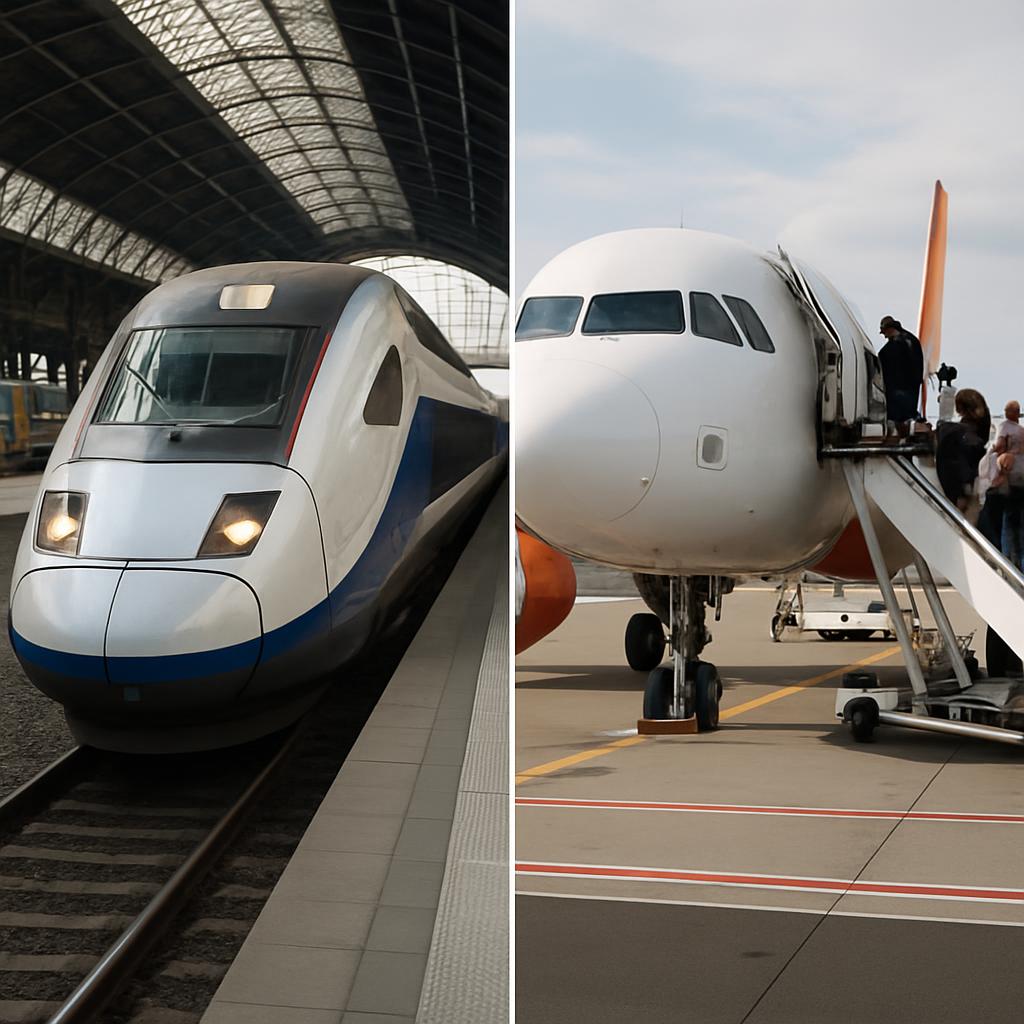
The bottom line for 2026: if your trip covers 5 or more long-distance journeys across 3+ countries with flexible dates, and you’re routing mostly through Germany, Austria, Switzerland, or Scandinavia, a Eurail Flex Pass is very likely to save you money and stress. If your dates are fixed, your route touches France, Italy, or Spain’s high-speed network heavily, or you’re covering long distances between countries with weak direct rail links, book budget flights 6–8 weeks ahead and price in one checked bag from the start. For most travelers doing a mix of both, the smartest approach is running the 20-minute checklist above before committing to either — the “right” answer changes trip by trip, and the few minutes spent comparing real fares is the cheapest insurance against overpaying either way.
Disclosure: This post contains affiliate links. We may earn a commission at no extra cost to you.