
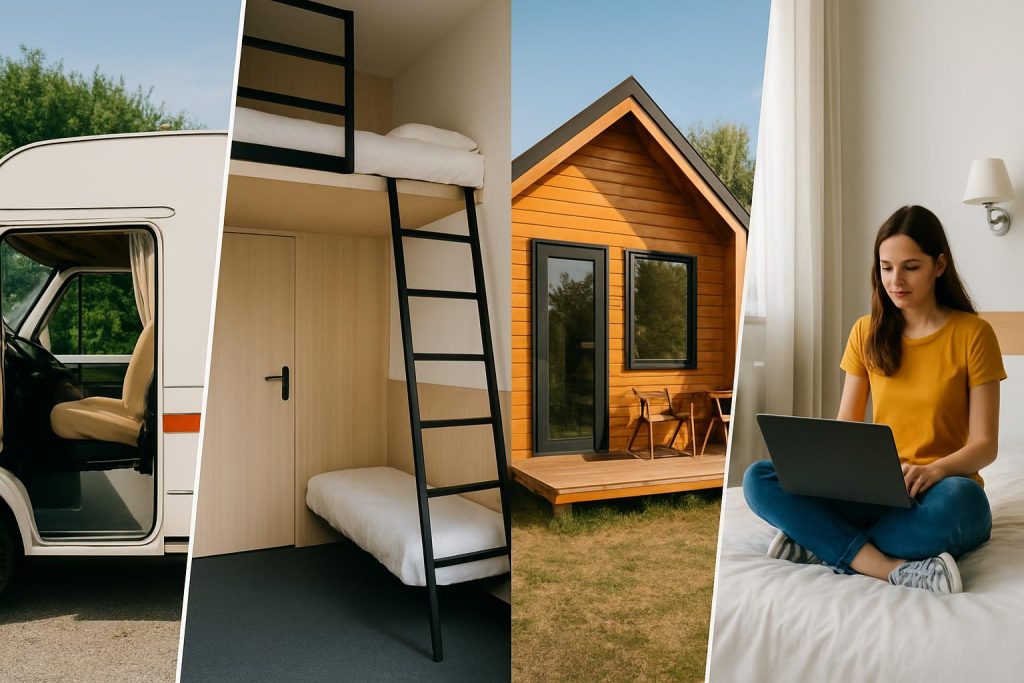
- Dorm beds remain cheap in Southeast Asia ($6–12) but have risen in Europe, East Asia, and Latin American hubs, often with hidden add-on costs.
- House sitting and work exchanges can drop nightly accommodation costs to near zero in exchange for time or commitment.
- Monthly-discounted apartment rentals and family-run guesthouses or homestays offer affordable longer-stay options.
- Hospitality networks like Couchsurfing provide free stays and local connections for flexible travelers.
Introduction: Why 2026 Is the Year to Look Beyond the Dorm Bed
If you assumed hostels were always the cheapest bed in town, 2026 is the year to rethink that. A dorm bed in Southeast Asia still runs about $6–12 per night, but in Europe, East Asia, and tourist-heavy Latin American hubs, dorm prices have crept upward — and once you add lockers, towels, and overpriced hostel bar drinks, the “budget” math gets fuzzy fast. Meanwhile, an entire ecosystem of alternatives can drop your nightly accommodation cost to near zero if you’re willing to trade time, flexibility, or a longer commitment.
This guide breaks down the realistic options beyond hostels: house sitting, work exchanges, monthly-discounted apartment rentals, family-run guesthouses and homestays, and hospitality networks like Couchsurfing. Every price below comes from current 2026 platform listings and recent traveler data — not guesswork. We’ll cover what each costs, who each suits, and the specific pitfalls that turn a “free” stay into an expensive headache.
The core insight driving all of this: the cheapest accommodation in 2026 is rarely a transaction you complete in five minutes on a booking app. It’s usually a relationship — with a pet owner, a host family, or a long-stay landlord — that rewards planning, a solid profile, and clear communication. Get those right, and you can travel for months while spending less on a bed than most people spend on coffee. Let’s get into exactly how.

What should you look for in cheap accommodation beyond hostels?
Look for three things: a low all-in cost (membership plus per-night plus hidden fees), a trust-and-safety system you can verify, and a good match between the option and how long you plan to stay. The cheapest model on paper is useless if it doesn’t fit your trip length, your destination, or your tolerance for uncertainty.
Start with the true cost, not the headline price. A house-sitting membership might be “free accommodation,” but you still pay an annual fee and sometimes a per-sit charge. For example, TrustedHouseSitters now applies a booking fee that is a “$12 USD / £9 charge applied every time a sit is confirmed,” paid separately by sitter and homeowner unless one is on Premium. That changes the math entirely if you only do one or two sits a year, so always calculate cost-per-night including every fee before committing.
Second, weigh the trust infrastructure. The better platforms now treat identity verification as a baseline rather than a perk — homeowners increasingly use its presence or absence as a quick signal when reviewing applications. Read recent reviews (last month, not last year), look for repeated patterns rather than one-off complaints, and always do a video call before confirming anything. Third, match the model to your timeline: hospitality networks suit a few nights, work exchanges and house sits suit one-to-four weeks, and monthly rentals only pay off at 28+ nights.
Which cheap accommodation option is best for your travel style?
The best option depends on how long you stay, whether you’ll trade labor or care for lodging, and how much certainty you need. House sitting and monthly rentals favor planners; work exchanges suit slow travelers; hospitality networks favor flexible, social travelers staying just a few nights. Below are the four models that consistently beat hostels on cost in 2026.
House sitting: free stays in exchange for pet and home care
House sitting is the closest thing to genuinely free accommodation for travelers who like animals and can commit to set dates. You pay only an annual membership; the stay itself is unpaid on both sides. According to platform pricing as of March 2026, membership fees range from about $29 to $259 per year, with Mind My House at roughly $29 the cheapest international option and TrustedHouseSitters at the premium end. The savings can be dramatic over time — one full-time sitting couple reported their accommodation savings dwarf every other travel cost across 175+ nights of sits.
The tradeoff is responsibility and competition. You’re caring for someone’s pets daily, you can’t leave on a whim, and popular listings fill fast — on the largest platform, competitive listings can close after just five applications, so a polished profile and instant alerts are essential. Note that as of early 2026, TrustedHouseSitters still showed over 10,000 active listings globally, with the strongest reach in the UK, USA and Europe.
Work exchange: a few hours of help for a bed (and often meals)
Work exchanges trade roughly 4–5 hours of daily help — hostel reception, farm work, childcare, hospitality — for accommodation and frequently meals. The two leading platforms are priced almost identically: Workaway’s standard solo membership costs from $69 per year (about $79 for a couple) as of January 2026, while Worldpackers’ solo plans run roughly $49–$59 a year, often discounted further with a promo code. Workaway is the bigger directory — over 50,000 opportunities in 170+ countries — while Worldpackers leans more curated and beginner-friendly with added safety features.
For long, slow trips this is arguably the best value of all: a month-long exchange in Southeast Asia or Central America can save $400–$800 in accommodation, meaning even a Pack plan around $99/year pays for itself in the first week. Just remember the fee buys platform access, not a guarantee — screen hosts carefully, ask about hours and days off, and keep emergency money aside in case a placement doesn’t match its description.
What do real-world results and reviews show about these options?
Real-world data confirms that beyond-hostel options reliably beat dorm prices when matched to the right trip length — but each carries documented friction worth knowing before you pay. The savings are real; so are the caveats.
On monthly rentals, the discounts are substantial and verified. Airbnb’s monthly discount applies automatically to bookings of 28 nights or more, and recent AirDNA data shows 30-day trips in Austin coming out about 47% cheaper per night than one-night stays, with similar deep discounts in Los Angeles and Phoenix. Demand has shifted hard toward this format — a January 2026 Furnished Finder/AirDNA report found monthly rentals are now 19% of total US rental demand, climbing to 33% in urban markets. In cheaper destinations the effect is even more striking: a Bali villa example saw a 60% monthly discount drop the nightly rate to about $29.
Hospitality networks tell a more cautionary story. Couchsurfing remains a way to get free stays plus local connection, but it moved to a paid model and now draws frequent complaints. Numerous reviewers report being charged unexpectedly for verification without clear disclosure. The base membership itself is small — roughly $14.99–$19.99 annually as of 2024 — and free alternatives like BeWelcome and Trustroots still preserve the original no-fee model. Meanwhile, family-run guesthouses quietly undercut hostels in much of Southeast Asia: in Vietnam, travelers describe a $8 private guesthouse room being cleaner than a $6 dorm bed, and walk-in low-season rates can run 20–40% below online prices.

How do the top cheap accommodation options compare in 2026?
Here’s a side-by-side of the five main beyond-hostel options, using current 2026 pricing and the trip lengths each actually suits. Treat the “effective nightly cost” as a planning estimate — your real number depends on how often you use the platform and where you go.
| Option | Typical 2026 cost | Best trip length | Effort / commitment | Best for |
|---|---|---|---|---|
| House sitting | ~$29–$259/yr membership; +$12/sit on some non-Premium tiers | 1–4+ weeks per sit | High (daily pet/home care, fixed dates) | Pet lovers, planners, slow travelers |
| Work exchange (Workaway / Worldpackers) | ~$49–$99/yr membership; bed + often meals | 1 week to several months | Medium-high (~4–5 hrs/day work) | Long-stay budget travelers, skill-builders |
| Monthly Airbnb / apartment | Often 30–60% off nightly rate at 28+ nights | 28+ nights | Low (just book) | Digital nomads, base-building stays |
| Guesthouse / homestay | ~$8–$34/night (SE Asia); walk-in often 20–40% cheaper | Any length | Low | Couples, privacy seekers, culture-first travelers |
| Hospitality networks (Couchsurfing/BeWelcome) | Free–~$20/yr (Couchsurfing); BeWelcome free | 1–3 nights | Medium (social effort, reciprocity) | Flexible, social, short-stay travelers |
The pattern is clear: short stays favor guesthouses and hospitality networks, medium stays favor work exchanges and house sits, and long stays favor monthly rentals. Stacking them across a single trip — a few couch nights, a two-week sit, then a monthly apartment — is how experienced budget travelers keep their average nightly cost near rock bottom without committing to any one model for the whole trip.
How do you choose the right cheap accommodation for your trip?
Choose by working backward from your trip length and risk tolerance, then run the all-in cost math before paying any membership. The right choice is almost always the one that matches how long you’ll stay in each place — not the one with the lowest headline price.
A step-by-step selection checklist
- Map your stay lengths first. Under 3 nights → hospitality network or guesthouse. One to four weeks → work exchange or house sit. 28+ nights → monthly rental discount.
- Calculate true cost-per-night. For house sitting, add membership + any per-sit fee, then divide by total nights you’ll actually sit. Remember a $129 membership with ten sits effectively costs about $249 in platform fees, not $129 once the per-sit charge is included.
- Check coverage in your exact destinations. Browse listings (free on most platforms) for your target countries and dates before paying. Regional platforms sometimes win: Nomador, for instance, dominates France with far more listings there than the global leaders.
- Verify safety features. Confirm ID verification, read last-month reviews, and require a video call before committing to any sit, exchange, or host stay.
- Budget an emergency fallback. Keep enough cash for a few hostel or guesthouse nights in case a host cancels or a placement disappoints.
Common mistakes and how to avoid each
- Mistake: Buying a house-sitting membership for one trip. Fix: If you’ll do fewer than ~6 sits a year, staying on a basic tier and paying the per-sit fee is usually cheaper than upgrading — run your own usage numbers first.
- Mistake: Booking a monthly rental at a hostel-like price expecting flexibility. Fix: Monthly Airbnbs can be canceled by hosts, leaving you scrambling — book early, read cancellation terms, and have a backup.
- Mistake: Treating a work exchange like a free hotel. Fix: It’s labor; confirm hours, days off, meals, and privacy in writing before accepting.
- Mistake: Paying for Couchsurfing verification without realizing it. Fix: Read the checkout screens carefully, since verification charges have surprised many users; consider free alternatives like BeWelcome.
- Mistake: Booking guesthouses online without checking walk-in rates. Fix: In Southeast Asia, low-season walk-in prices can be 20–40% cheaper than online — and longer stays often earn an extra 10–15% off.
If you only adopt one habit from this section, make it the cost-per-night calculation. Travelers consistently overpay by joining the most-marketed platform rather than the one that fits their actual itinerary. A $29 membership you’ll use ten times beats a $259 membership you’ll use twice — every time.
Conclusion: The Bottom Line on Cheap Stays in 2026
In 2026, the cheapest bed is no longer automatically a hostel dorm. Between house sitting (a $29–$259 annual fee for effectively free stays), work exchanges (around $49–$99/year for a bed plus meals), monthly rental discounts that can cut nightly rates by 30–60%, and family-run guesthouses that often undercut dorms outright, budget travelers have more genuinely affordable options than ever. The catch is that the best deals reward planning, a strong profile, and a willingness to trade time or commitment for savings.
The practical next step is simple: decide how long you’ll stay in each destination, then pick the model that matches. Browse listings for free before paying any membership, calculate your true all-in cost-per-night, verify safety features, and always keep a small fallback budget. Stack two or three models across a longer trip and your average nightly cost can drop to a fraction of what hostels would charge.
None of these options are risk-free, and prices and platform policies change frequently — verify current fees on the official sites and read recent reviews before booking. Choose deliberately rather than defaulting to the most-advertised platform, and 2026 can be the year you travel longer, more comfortably, and for less than a dorm bed ever cost you.
Frequently Asked Questions
Book Unforgettable Tours & Experiences
Skip the tourist traps. GetYourGuide connects you with top-rated local guides and hand-picked activities — with free cancellation on most bookings.
If you’re ready to try one of these models, the platforms mentioned throughout — TrustedHouseSitters, Mind My House, Nomador, Workaway, Worldpackers, and the major booking sites for guesthouses and monthly rentals — each let you browse listings for free before committing. Start by browsing your target destinations and dates on a couple of them to see where the listings and best prices actually live, then sign up only for the one that fits your trip. Many offer referral or promo discounts at sign-up, so check for a current code before you pay.
Disclosure: This post contains affiliate links. We may earn a commission at no extra cost to you.